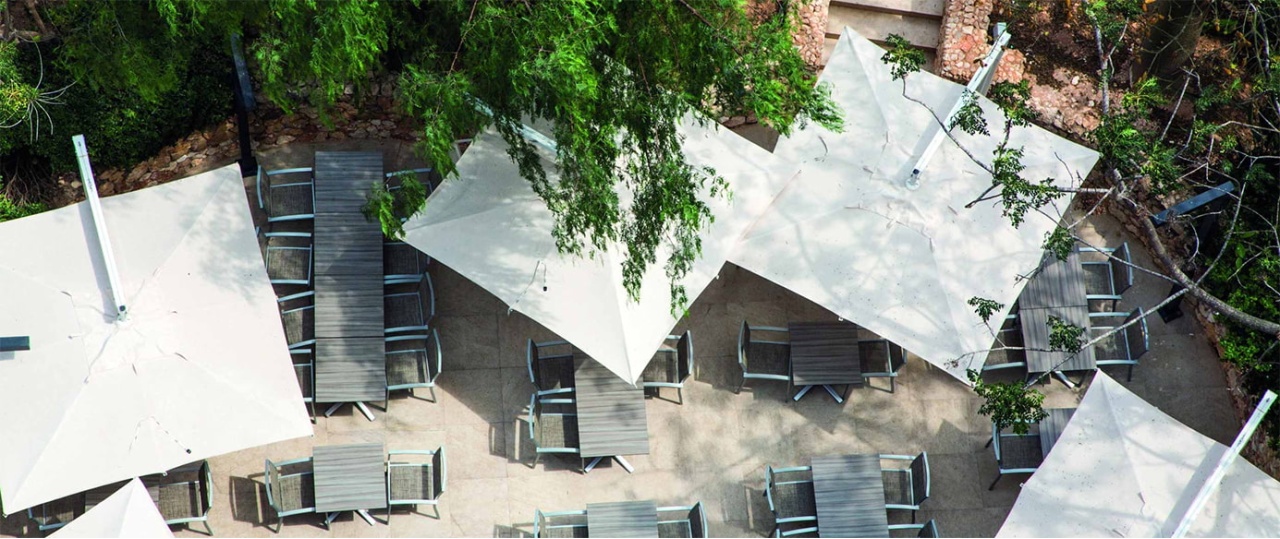
Professional restaurant parasols fail not because of sun exposure and not because the structure is “weak”. In the vast majority of cases, failures are the combined result of wind loads, installation mistakes and incorrect staff actions.
Even in contract-grade hospitality systems (including Scolaro-level models), the same failure patterns repeat again and again.
The main causes of restaurant parasol breakages are gusty wind, an incorrect base or installation, and closing the canopy too late. The ribs are almost always the first component to fail because they take the dynamic load. Even professional hospitality parasols require engineering-correct installation and clear operating rules for staff.
1. Why ribs are the first failure point
Based on service patterns, in 70–80% of operational failures the ribs are the first parts to break.
The mechanics, explained
- wind is not a static pressure — it is a dynamic, impulsive load;
- the canopy starts to pulse and “work”;
- the load concentrates on 1–2 ribs;
- micro-deformation appears (often invisible);
- the next gusts trigger a chain failure.

After a strong gust, a parasol may look fine while being structurally damaged. That’s why “it broke out of nowhere” is a very typical scenario.
2. Incorrect installation cuts service life dramatically
From hospitality practice (including cases where clients openly admitted it): installation errors are one of the fastest routes to repairs.
Common installation mistakes
- insufficient ballast or the wrong base type;
- choosing the base “by canopy size” instead of real wind load;
- no anchoring where it is critical;
- a tilted mast due to an uneven surface;
- no post-install checks of joints and mechanisms.
With professional terrace parasols, engineering accuracy doesn’t forgive “almost correct”.
3. Why cantilever parasols with wooden structures don’t work in restaurants
Many operators follow the same path: wooden cantilever models → recurring failures → complete refusal of the format.
- wood performs poorly under torsion;
- high sensitivity to moisture and temperature swings;
- micro-cracks around joints;
- cantilever geometry amplifies loads on ribs.

That is why, in real hospitality operations, the most common survivors are centre-pole parasols and metal telescopic systems.
4. Wind in plain language: what the numbers mean
| Wind speed | What it looks like in reality | Risk for the parasol |
|---|---|---|
| 10–20 km/h | Light leaf movement | Safe |
| 20–30 km/h | Thin branches bend | Canopy starts to “breathe” |
| 30–40 km/h | Hard to walk against the wind | Critical zone for ribs |
| 40–50 km/h | Branches break | High deformation risk |
| 50+ km/h | Storm gusts | Emergency failures |
Parasols fail not in steady wind, but in sudden gusts. With an average wind of 20–25 km/h, gusts can easily reach 40–50 km/h — and those gusts break ribs first.
Level 5 (29–38 km/h) is the danger zone where many operators still keep parasols open, yet this is where invisible damage often begins.

The most dangerous conditions for restaurant parasols are short gusts that exceed the design limits of a specific structure.
Recommended wind limits for Scolaro parasols
Although professional Scolaro parasols are tested under elevated loads, the manufacturer does not recommend and does not warrant the use of collapsible parasols when wind conditions exceed certain thresholds.
Below are indicative upper wind-speed thresholds for different system types (actual values depend on configuration, base type and installation):
- Up to ~20 km/h — standard parasols with cantilever or centre pole (e.g., GALILEO, GALAXY, ASTRA, PALLAIO collections)
- Up to ~40 km/h — reinforced large-format parasols with a centre pole only, when used with a permanent anchoring system (e.g., CAPRI, VERONA collections)
- Up to ~60 km/h — fixed architectural shade systems (not collapsible parasols; engineered structures with dedicated anchoring)
These values are not a permission to operate at the stated wind speed. They define the upper engineering limit. For restaurant terraces, the practical rule is to close the parasol much earlier — as soon as gusts appear.

Hospitality parasol manufacturers clearly limit allowable wind loads. Most restaurant parasols should be closed already at gusts from around 25–30 km/h. Exceeding those conditions leads to broken ribs, joint deformation and loss of warranty cover.
5. Matrix: which parasol type for which wind scenario
| Parasol type | Stability | Vulnerability | Practical conclusion |
|---|---|---|---|
| Centre pole | High | Low | Safest operational choice |
| Telescopic | High | Medium | Correct base is critical |
| Cantilever (metal) | Medium | Higher | Requires staff discipline |
| Cantilever (wood) | Low | Very high | Not recommended for hospitality |
6. The biggest staff mistake
“Let’s serve dessert first — we’ll close it after.”
This is exactly when:
- the canopy is working under gusts;
- staff try to close the parasol in the wind;
- ribs and mechanisms take a shock load.
One-page staff checklist
Close the parasol IMMEDIATELY if:
- wind bends branches;
- the canopy pulses or visibly “works”;
- sharp gusts appear;
- the terrace is temporarily not in use;
- staff cannot control the situation.
DO NOT
- attempt to close the parasol during gusts;
- ignore a leaning/tilted mast;
- leave an open parasol “for a minute” or “overnight”.
FAQ: restaurant parasol failures
Why do ribs break most often?
Because ribs take the dynamic load first when wind gusts hit the canopy.
Is the manufacturer to blame?
In most cases, no — the cause is installation, wind conditions or incorrect operation.
When should a parasol be closed?
At gusts from around ~25–30 km/h, especially on exposed terraces.
Why are wooden cantilever parasols a bad idea?
Because they are highly sensitive to torsion, moisture and gusty wind.