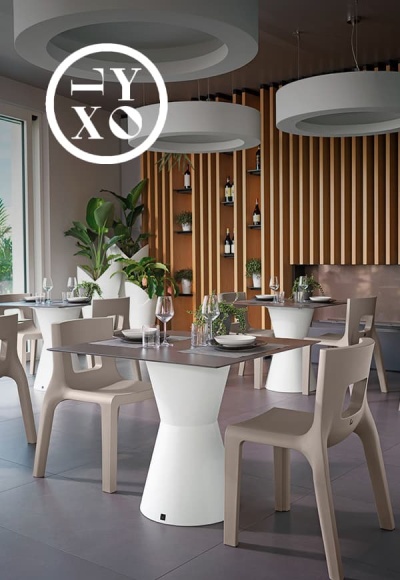
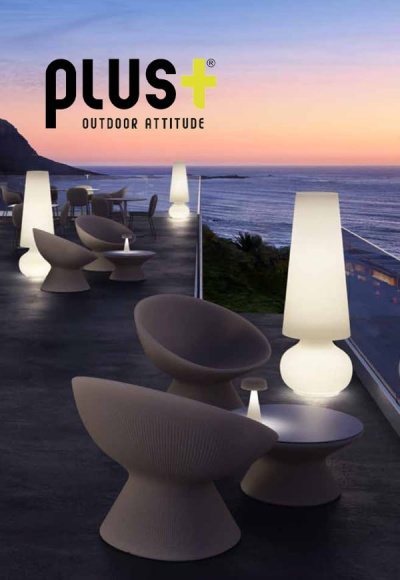
Professional restaurant and hospitality lighting combines ambient, task, accent and decorative light to support visibility, guest comfort and the atmosphere of a commercial interior. Restaurants, cafés, bars and hotels may use pendant, wall, table, floor and directional lighting, with each fitting selected according to the function of the space, lighting performance and interior concept.
Restaurant lighting works best as a coordinated scheme rather than a collection of individual decorative fittings. Dining tables, bars, circulation routes, entrances, waiting areas and architectural features all have different lighting requirements.
HoReCa.Furniture offers commercial lighting for restaurants, cafés, bars, hotels and other hospitality interiors from European manufacturers. Lighting can be specified alongside our restaurant and hospitality furniture to coordinate the furniture layout, lighting scheme and wider interior design.
Restaurant lighting requires several layers of light
A single type of lighting rarely performs every function well. Ambient light provides overall visibility, task and local lighting support specific areas, accent lighting draws attention to architecture and interior features, while decorative lighting contributes to the identity of the venue.
Layering these elements also makes it possible to adapt the atmosphere between daytime and evening service where the lighting system and controls allow it.
Specification principle: define what each area needs the light to do before choosing the luminaire. Appearance matters, but it cannot replace appropriate light distribution and performance.
Types of lighting used in restaurants and hospitality interiors
Pendant lighting
Pendant lights are commonly used above dining tables, bar counters and furniture groups to create focused light and a strong visual feature.
Suspension height, scale, light distribution and the relationship with the table are all important. A pendant should support the dining setting without creating an uncomfortable obstruction within guests' sightlines.
Floor lamps
Floor lamps can provide local, supplementary or decorative lighting alongside sofas, lounge chairs, waiting areas and hotel lobby seating.
Specification should consider the footprint, power supply, cable routing and circulation around the fitting. Outdoor use should only be assumed where the manufacturer explicitly permits it.
Table lamps
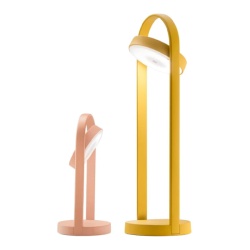
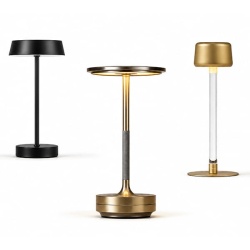
Table lamps have become particularly useful in hospitality interiors for creating an intimate pool of light directly at a dining table, bar or occasional table.
Compact proportions are important where food, glassware and tableware also need space. Rechargeable models introduce additional considerations such as battery life, charging and operational routines.
Wall lights
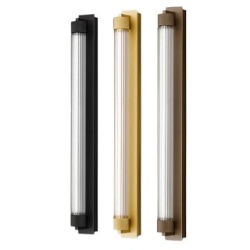
Wall lights can provide ambient, local, accent or decorative illumination without occupying a table or floor area. They are particularly useful along walls, circulation spaces and beside seating areas.
Mounting height and shielding should be considered carefully to avoid uncomfortable glare.
Spotlights and directional lighting
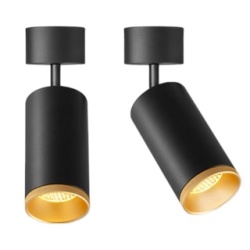
Spotlights and directional luminaires can highlight dining tables, bars, artwork, textured surfaces and architectural details.
The effect depends on beam angle, optical system, mounting position and distance from the illuminated surface.
Ambient, task, accent and decorative lighting
| Lighting layer | Role in the interior |
|---|
| Ambient | Provides the general level of light required to understand and move through the space |
| Local / task | Supports a particular table, bar or functional area |
| Accent | Highlights architecture, furniture, artwork and material details |
| Decorative | Contributes to atmosphere and the visual identity of the venue |
Lighting restaurant tables
Dining tables require enough light for guests to see food, drinks and one another comfortably without exposed sources becoming distracting or glaring.
Pendant lights, spotlights, wall lights and table lamps can all be used depending on ceiling height, electrical positions, interior design and the arrangement of restaurant dining tables.
Restaurants that frequently move or combine tables should also consider whether fixed pendant positions will restrict future layout changes.
Colour temperature and restaurant atmosphere
Colour temperature changes the way food, timber, upholstery and decorative finishes are perceived. Warmer light can support a more intimate atmosphere, while more neutral light may feel more active and functional.
There is no single colour temperature that is correct for every restaurant. The appropriate choice depends on the concept, daylight, interior palette and function of the particular area.
Colour rendering
Good colour rendering is particularly relevant where food, drinks and interior materials need to appear natural. For dining areas and other presentation-focused spaces, the colour-rendering characteristics specified for the light source should form part of the selection process.
Luminous output, beam angle and distribution
Wattage alone does not describe how a fitting will illuminate a space. Luminous output, optics, beam angle, mounting height, distance from the target surface and the reflectance of surrounding materials all influence the result.
Glare and visual comfort
A bright source within a guest's normal field of view may be uncomfortable even where the overall lighting level is adequate.
Suspension heights, spotlights and wall fittings therefore need to be considered in relation to the actual positions of tables and restaurant chairs, as well as reflective surfaces such as mirrors, glass and polished metal.
More light does not necessarily mean better lighting. Hospitality interiors require a balance between visibility, atmosphere, contrast and visual comfort.
Dimming and lighting scenes
Dimming can help adapt a venue between daytime and evening operation, but compatibility depends on the luminaire, light source, driver and control system. A product should not be assumed to be dimmable simply because it uses LED technology.
Lighting different areas of a restaurant
- dining areas — comfortable light for food and conversation;
- bar counters — a combination of functional and decorative lighting;
- waiting areas — softer local and ambient light;
- entrances — clear orientation and visual emphasis;
- circulation routes — visibility without unnecessary glare;
- artwork and architectural details — controlled accent lighting;
- hotel lounges and lobbies — layered ambient, local and decorative lighting.
Lighting and furniture should be planned together
A pendant relates directly to the table below it, a floor lamp to the sofa or lounge chair beside it, and directional light to the position of the object it is intended to illuminate.
For this reason, the lighting plan should ideally be developed alongside the furniture layout rather than after the interior has already been furnished.
Outdoor and terrace lighting
An indoor luminaire should not automatically be used outdoors. For terraces and exterior hospitality areas, check the manufacturer's intended application, IP rating, materials, electrical components and installation requirements.
What to check when specifying professional lighting
| Parameter | What to assess |
|---|
| Function | Ambient, local, accent or decorative role |
| Light performance | Output, beam and distribution required for the task |
| Colour temperature | Relationship with the interior and use of the area |
| Colour rendering | Especially important for dining and presentation areas |
| Controls | Dimming and system compatibility where required |
| Installation | Mounting, electrical points and access for maintenance |
| Scale | Relationship between the fitting, furniture and architecture |
| Environment | Suitability for indoor or outdoor use |
Common restaurant lighting mistakes
- selecting fittings only for appearance without considering their light output;
- using one uniform lighting layer throughout the entire restaurant;
- excessive brightness rather than controlled distribution;
- glare within guests' field of view;
- lighting that does not correspond with the furniture layout;
- unplanned mixing of colour temperatures;
- ignoring control requirements;
- using indoor fittings outdoors without suitable approval.
Professional lighting as part of restaurant design
Lighting fittings contribute to the visual identity of a restaurant even when they are not intended to be the dominant decorative feature. Scale, form, finish and material should therefore work with the furniture and architectural concept.
A visually striking luminaire, however, does not automatically provide all the functional light required. Successful hospitality lighting combines aesthetics with appropriate technical performance.
Professional restaurant and hospitality lighting
HoReCa.Furniture offers lighting for restaurants, cafés, bars, hotels and other hospitality interiors from European manufacturers, including pendant, floor, table, wall and directional lighting.
We can help specify products according to the furniture layout, purpose of each area, interior concept and technical requirements of the project.


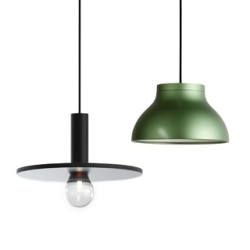 Pendant lamps
View category