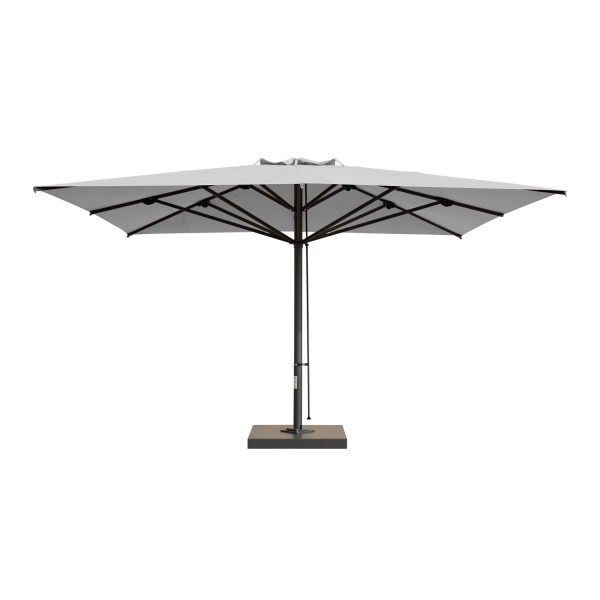
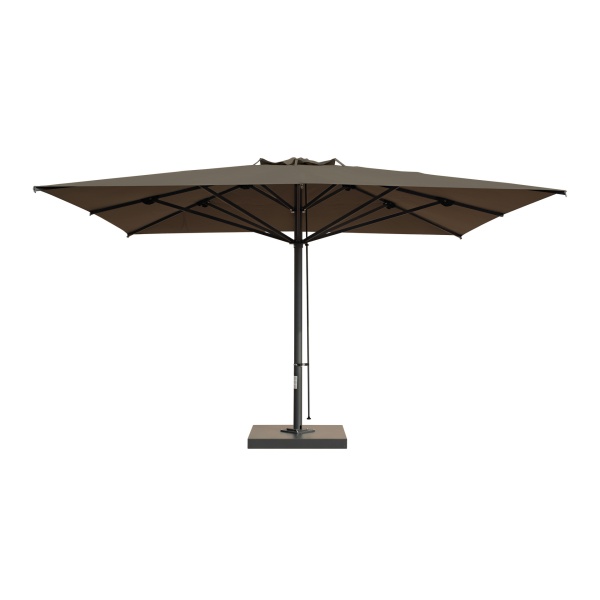
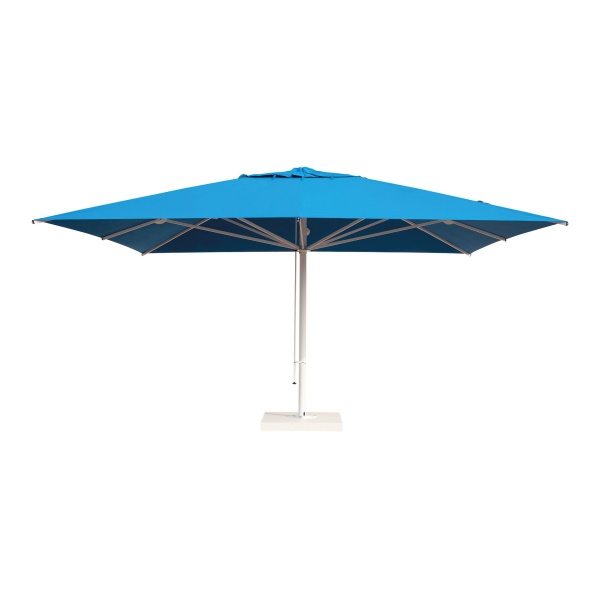
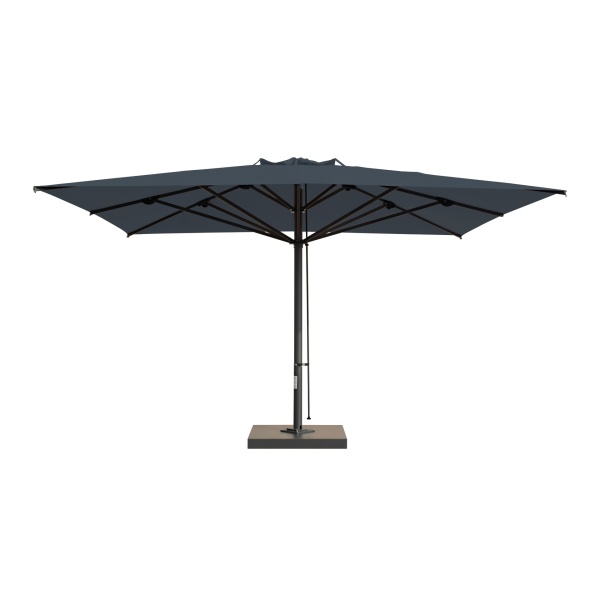
Terrace parasols for restaurants and cafés are contract shading structures for hospitality venues where shade forms part of the service model and the day-to-day operation of the outdoor area. A correctly specified parasol improves the usability of a terrace during sunny daytime hours and may also provide limited protection from light rain, depending on the canopy fabric, construction and manufacturer’s specification.
A parasol does not operate in isolation. It forms part of the wider outdoor furniture system, in which furniture, circulation routes, shading and service procedures should follow the same spatial logic.
In practice, the canopy size should be selected for the actual table layout rather than treated as a separate decorative element. It is therefore useful to specify outdoor chairs and parasols together.
The same applies to terrace tables. Their shape and dimensions influence whether the project requires a centre-pole parasol passing through the tabletop or a separate cantilever model with a side support. Selecting one component immediately affects the available options for the other.
Indicative planning reference: a round parasol measuring approximately Ø 2.5–3 m or a square model measuring 2.5 × 2.5 m may cover a compact four-seat table arrangement. A 3.5 × 3.5 m canopy may suit around six seats, while a 4 × 4 m format may cover approximately eight to ten seats. Actual coverage depends on canopy height, sun angle, table spacing and support position.
How terrace parasols affect outdoor service
Without effective shade, some terrace tables may remain unattractive during periods of direct sun. A professionally planned shading system helps make more of the outdoor area usable during daytime service, although the result depends on the orientation of the terrace, the season, the canopy layout and local weather conditions.
Outdoor parasols for cafés and restaurants can perform several functions at once: shade from direct sunlight, limited protection during light rain where the model is designed for it, visual zoning and integration of the terrace into the identity of the venue. In this context, a parasol is not simply an accessory but part of the operating infrastructure of the outdoor area.
Types of terrace parasol: choosing the right construction
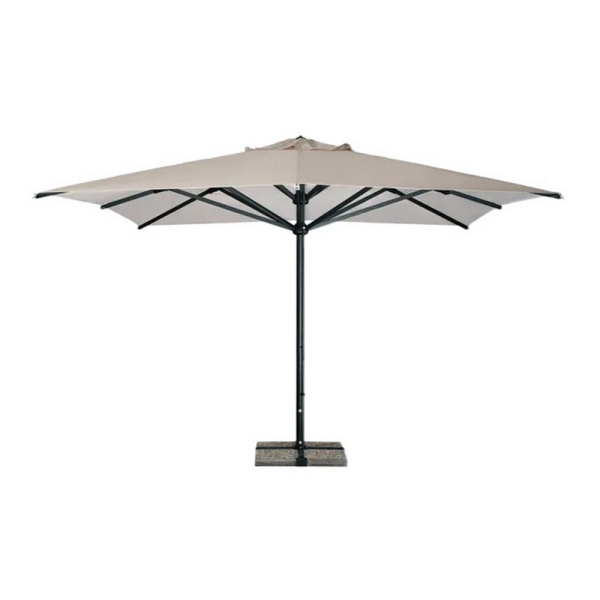
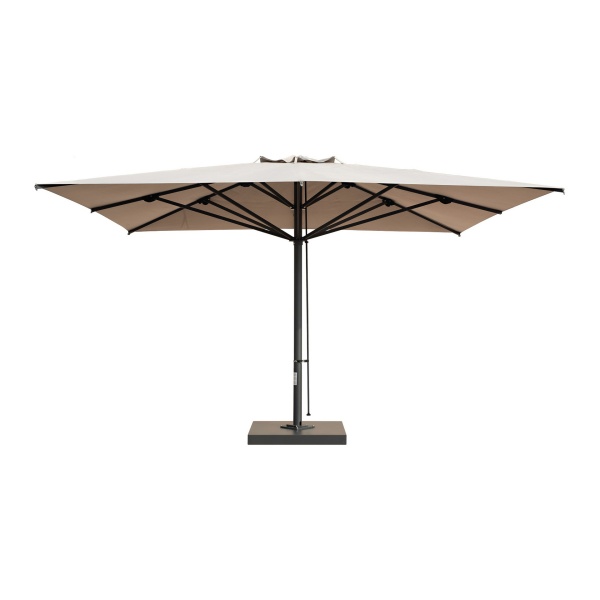
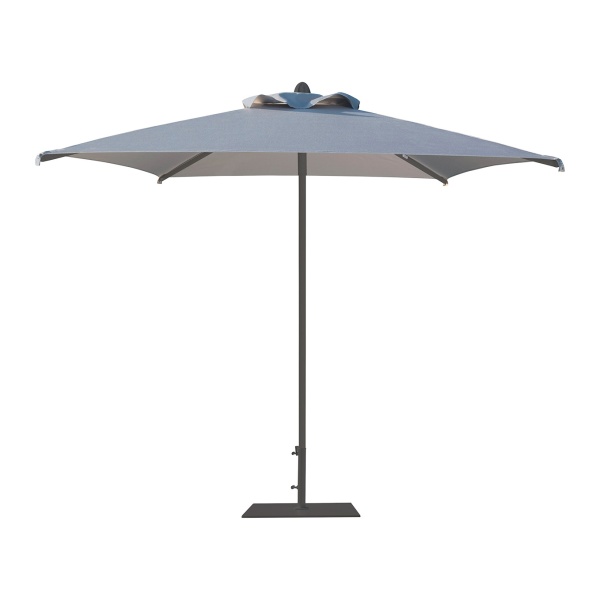
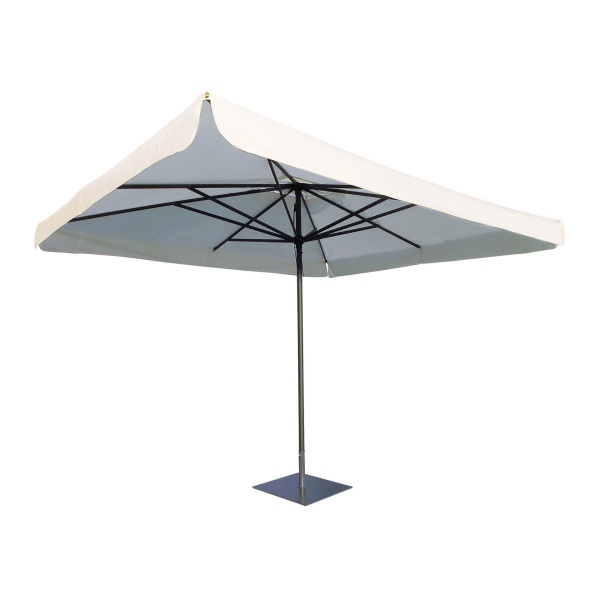
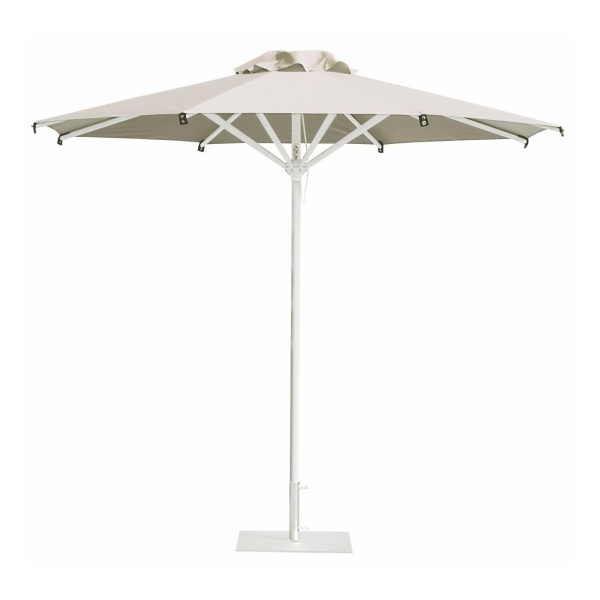
Centre-pole parasols are the classic and most widely used format. The mast passes through the centre of the canopy and is secured to a base or, where the table is designed accordingly, through an opening in the tabletop. They are suitable for compact café and coffee-shop terraces where one structure does not need to shade a very large area. Depending on the collection, formats may range from approximately Ø 2 m to Ø 5 m and square canopies from 3 × 3 to 4 × 4 m. The central mast occupies space within the seating layout and must be coordinated with the table.
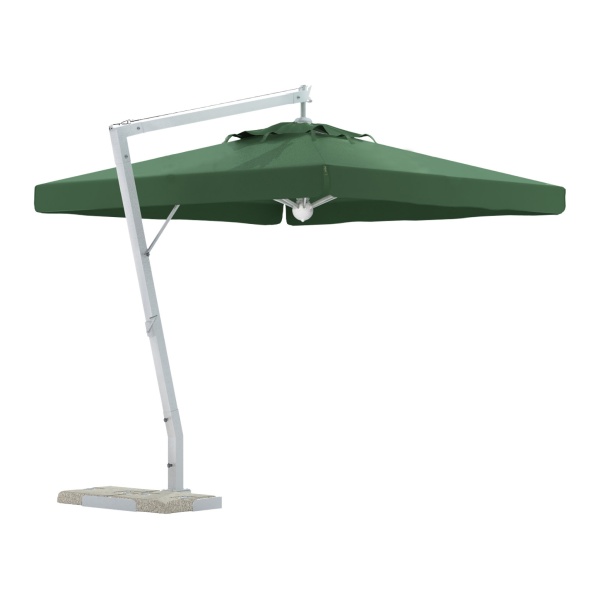
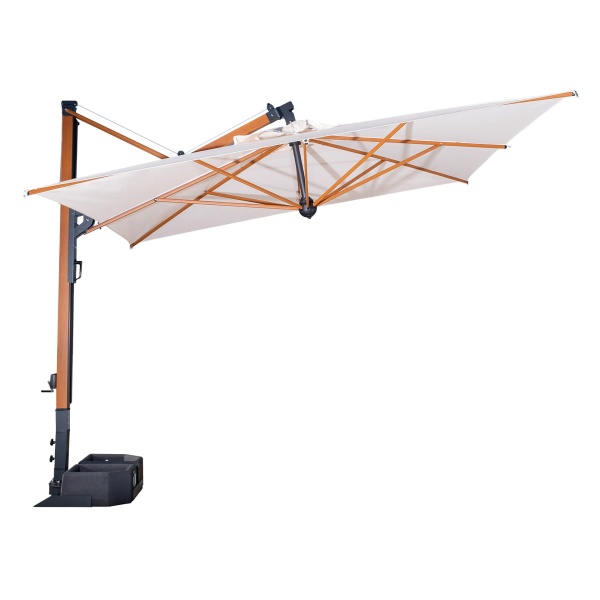
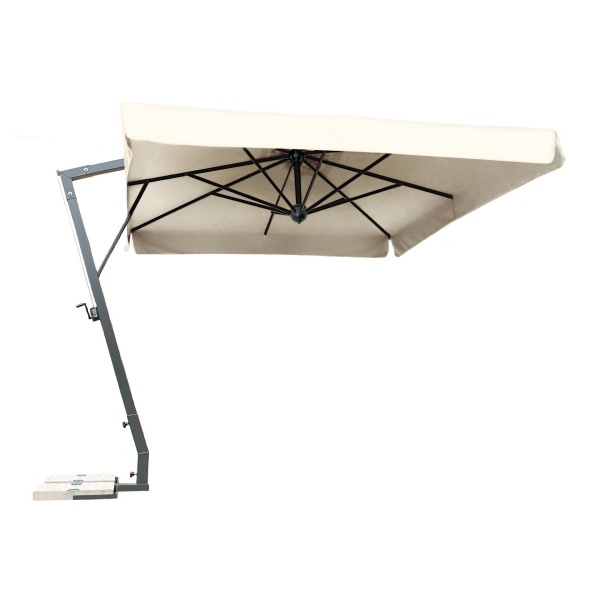
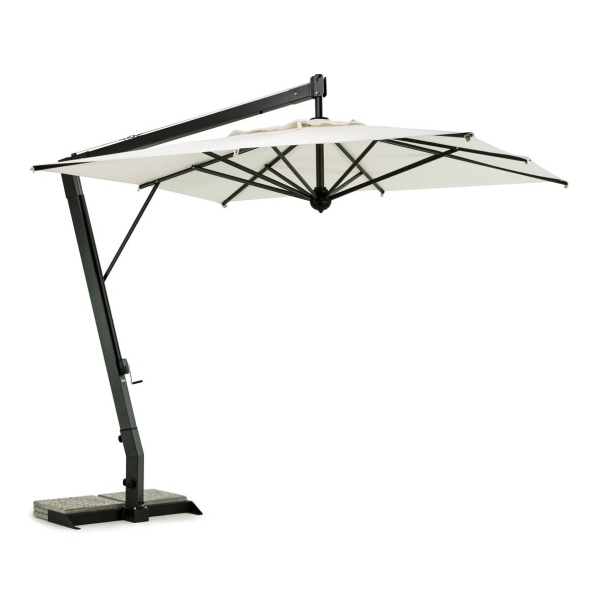
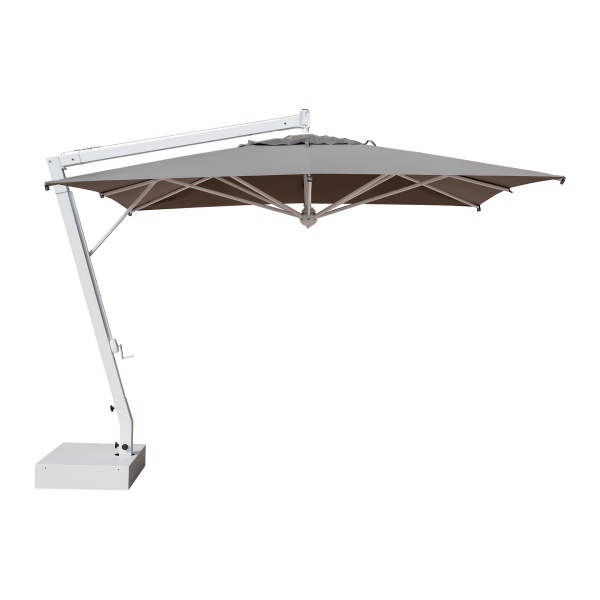
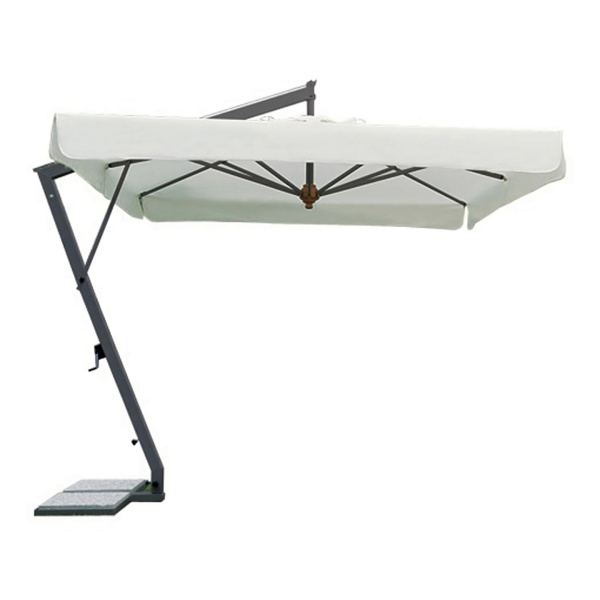
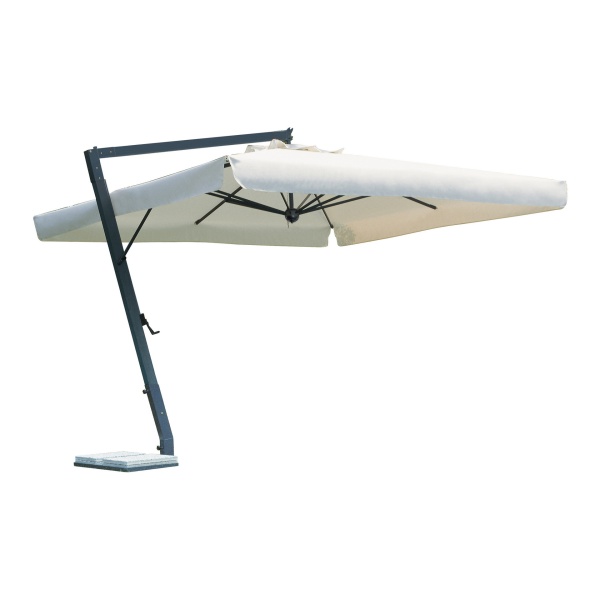
Cantilever parasols position the mast to the side of the canopy, leaving the area underneath unobstructed. Depending on the model, the canopy may rotate, tilt or offer several adjustment positions. Cantilever systems generally require a heavier mobile base or permanent anchoring because the offset mast creates greater leverage. The exact base weight and fixing method must follow the manufacturer’s specification.
Telescopic parasols use an opening mechanism that raises the canopy as it closes or opens, allowing it to operate above tables without requiring the furniture to be moved. They are particularly practical for densely furnished restaurant terraces.
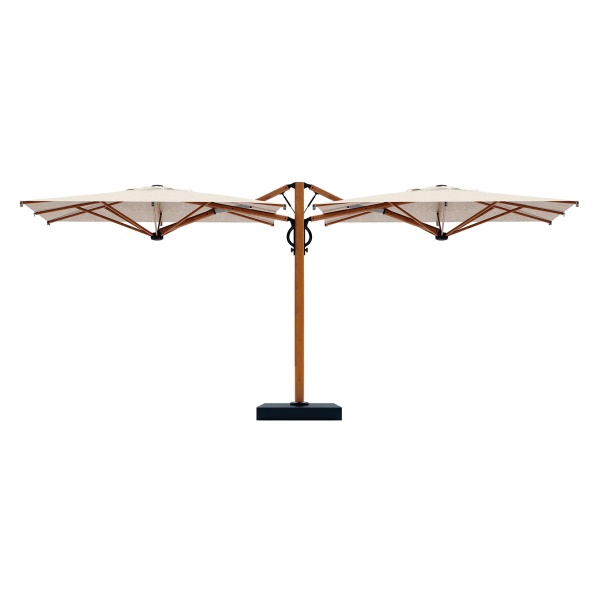
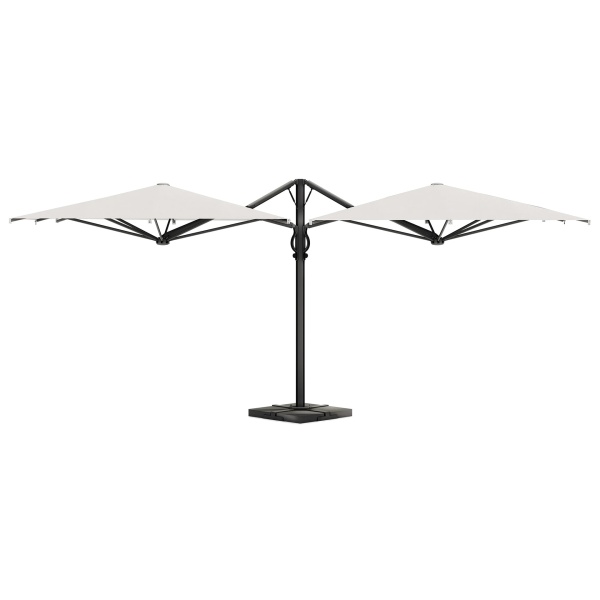
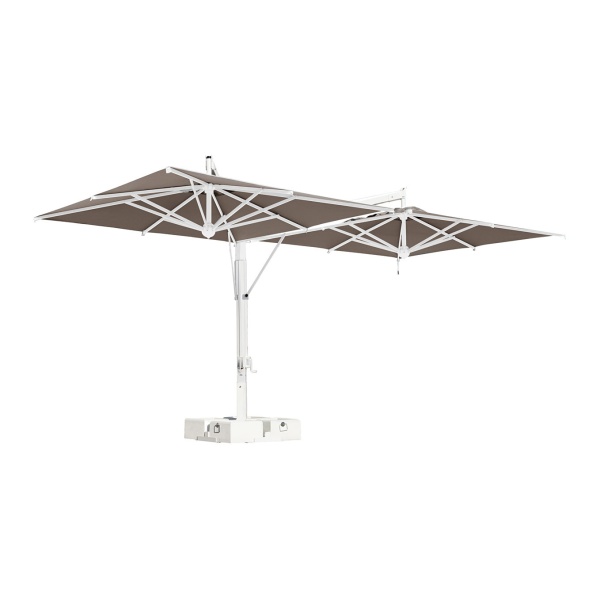
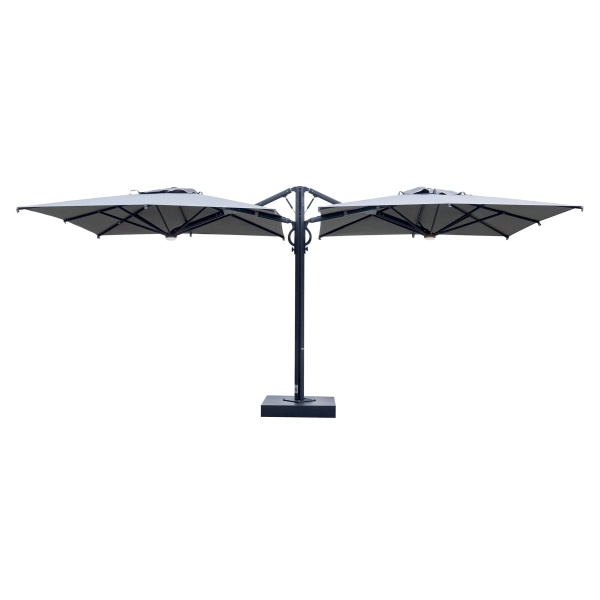
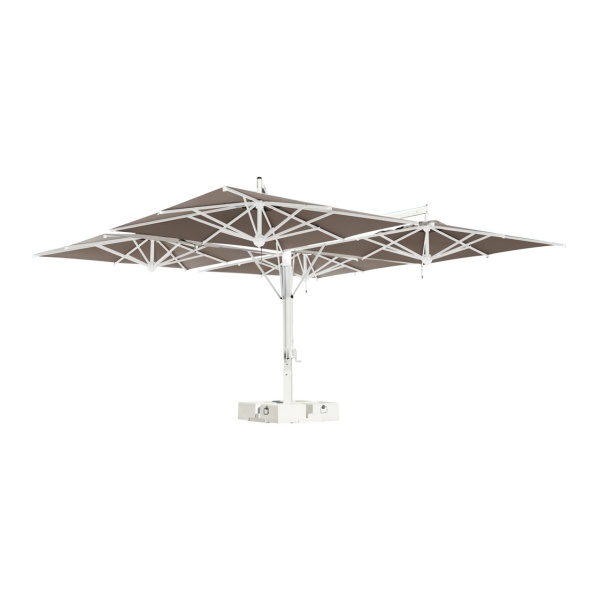
Double-canopy parasols use two canopies on one supporting structure or a V-shaped frame. Depending on the system, formats such as 3 × 6 or 4 × 8 m can create a continuous shaded line along a building or across a long terrace.
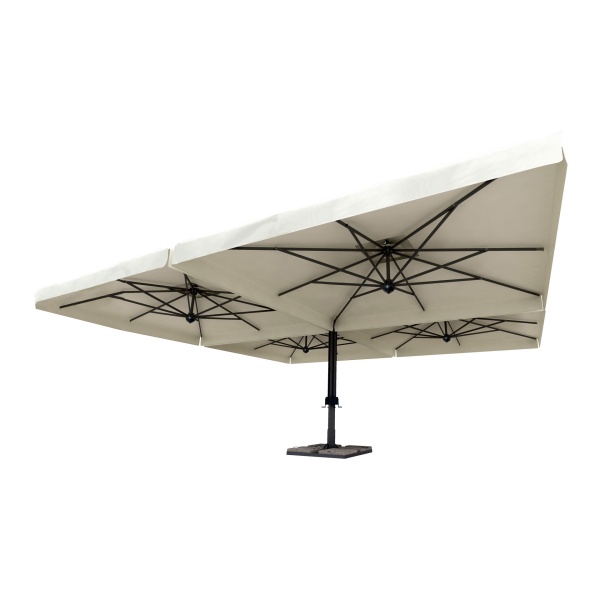
Four-canopy parasols combine four canopies around one central structure. Large configurations may cover areas approaching 6 × 6 m, depending on the model. They are intended for hotels, restaurants and beach clubs where a large area needs to be shaded with fewer structural supports.
Shade sails are tensioned triangular or rectangular membranes mounted between posts or structural anchor points. They provide a contemporary architectural appearance and can cover large areas, but require project-specific calculations for tension, anchoring, drainage and wind exposure.
| Parasol type | Indicative canopy formats | Base or fixing | Typical application |
|---|
| Centre-pole | Ø 2–5 m / 3 × 3–4 × 4 m | Mobile base or anchor according to model | Coffee shop, compact restaurant terrace |
| Cantilever | 3 × 3–5 × 5 m | Heavy base or permanent anchor | Restaurant, lounge and premium seating areas |
| Telescopic | 3 × 3–4 × 4 m | According to canopy and site specification | Densely furnished terraces |
| Double-canopy | 3 × 6–4 × 8 m | Permanent anchoring commonly required | Long terrace beside a building |
| Four-canopy | Up to approximately 6 × 6 m | Permanent anchoring commonly required | Hotel, large outdoor area, beach club |
Materials for commercial outdoor use
Aluminium frames are widely used for contract terrace parasols because aluminium is relatively lightweight and resistant to corrosion. The long-term performance of the structure depends on the profile dimensions, joints, fixings, surface treatment and maintenance. For coastal or highly exposed locations, the suitability of the finish should be confirmed in the technical documentation for the specific model.
Acrylic canopy fabrics, including solution-dyed outdoor textiles from manufacturers such as Sunbrella, Sattler or comparable suppliers, are commonly used for professional parasols. Depending on the fabric, specifications may include colourfastness, UV stability, water-repellent treatment and different fabric weights. These parameters must be checked for the selected textile rather than assumed for every acrylic canopy.
A canopy vent allows part of the airflow to pass through the upper section of the parasol and may reduce pressure on the canopy during gusts. It can improve airflow management but does not replace a correctly sized base, proper anchoring or the manufacturer’s wind-use instructions.
Wind conditions and the Beaufort scale
Wind exposure is one of the most important factors when selecting and operating a parasol on an open terrace. Some contract models, including selected Scolaro parasols, may have model-specific wind-test information. These figures should be checked in the documentation for the exact canopy size, base and installation method.
| Beaufort force | Approximate wind speed | General description | Operational guidance |
|---|
| 1–3 | Up to 19 km/h | Light breeze | Operate according to the model instructions |
| 4–5 | 20–38 km/h | Moderate to fresh breeze | Check the fixing and follow the manufacturer’s closing guidance |
| 6 | 39–49 km/h | Strong breeze | Close and secure the parasol unless the manufacturer explicitly states otherwise |
| 7 and above | From 50 km/h | Near gale and stronger conditions | Keep the parasol closed and secured |
There is no universal wind rating applicable to all contract parasols. Permitted wind exposure depends on the model, canopy size, base or anchoring system, whether the parasol is open or closed and the surrounding architecture. A canopy vent does not automatically increase the permitted rating by a fixed number of Beaufort levels.
Base and fixing: what determines stability
Incorrectly specified bases and fixings are a common cause of instability. The required solution depends on canopy dimensions, mast position, parasol weight, wind exposure, surface type and whether the installation needs to remain mobile.
A 3 × 3 m centre-pole parasol may use a heavy mobile base or a permanent fixing, depending on the model and location. A cantilever parasol of the same dimensions normally requires a more substantial base or anchoring because of the offset load. Double- and four-canopy structures commonly require permanent project-specific anchoring.
Parasol bases may be made from metal, granite, concrete or modular weighted elements. Granite slabs can be placed in a cross frame, while wheeled metal bases make movement easier. Exact weight and compatibility must be confirmed with the parasol manufacturer.
Branding and custom canopy options
For restaurant chains, hotel groups and franchises, a branded parasol can form part of the visual identity of the outdoor area. Depending on the supplier and fabric, customisation may include selected colours, logos or graphic elements applied by an appropriate printing method.
Selected Scolaro models may be available with made-to-order fabric colours or branding. Minimum quantities, available printing methods and production lead times depend on the parasol model, canopy fabric and current factory conditions and should be confirmed before ordering.
Functional options: LED lighting and heating
Depending on the model, terrace parasols may be equipped with LED lighting integrated into the ribs, mast or perimeter of the canopy. This can improve visibility and support evening service without requiring separate freestanding lighting around every table.
Some professional systems also support compatible infrared heaters. Heating may make selected terrace areas more comfortable during cooler evenings or transitional seasons, but performance depends on ambient temperature, wind exposure, the openness of the space, heater output and local installation requirements.
Choosing a parasol for the venue format
For a coffee shop or compact bistro terrace, round or square centre-pole parasols measuring approximately Ø 2.5–3 m can be practical. The base, fabric and fixing method should be selected according to the model and the wind exposure of the site.
For a mid-range or premium restaurant, cantilever or telescopic parasols measuring approximately 3 × 3–4 × 4 m may provide more flexible furniture layouts. Options such as an acrylic canopy, canopy vent and LED lighting depend on the model and the required service scenario.
For large hotel and beach-club areas, double- or four-canopy structures can create larger continuous shaded areas, generally with permanent anchoring. For beach and poolside areas, use the separate category of beach parasols, coordinated with sun loungers and sunbeds.
For a coordinated terrace scheme, parasols should be selected together with the other products in the terrace furniture category so that materials, colours, proportions and operating requirements remain consistent.
A contract terrace parasol is an operational component rather than a seasonal decoration. Its value depends on the correct combination of structure, fabric, base or anchor, furniture layout and daily operating procedure.