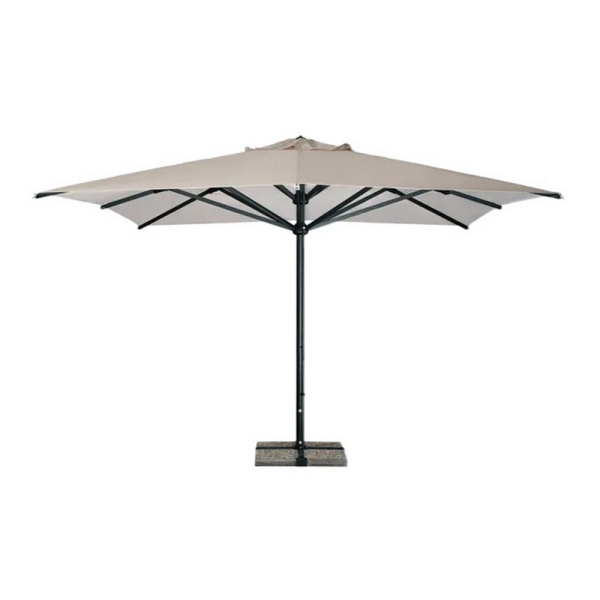
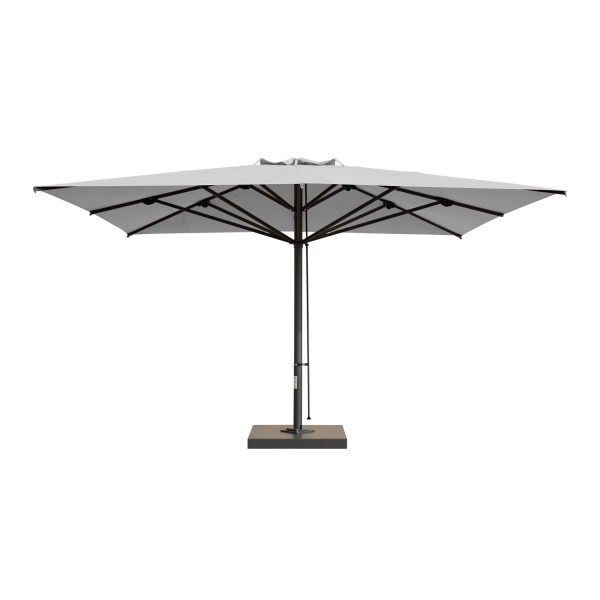
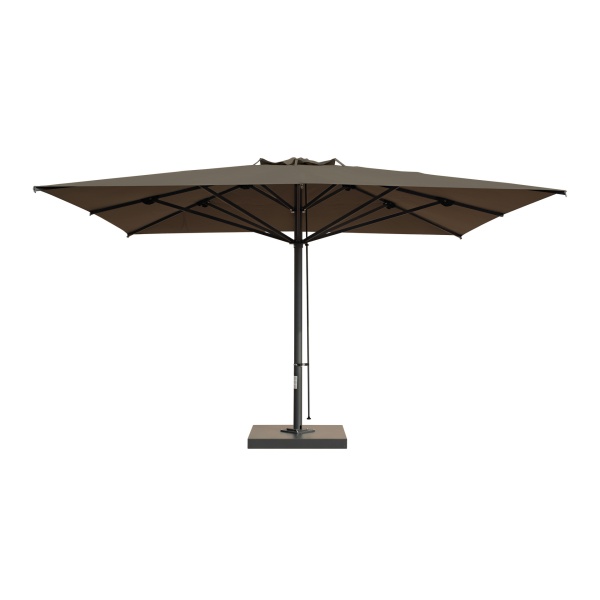
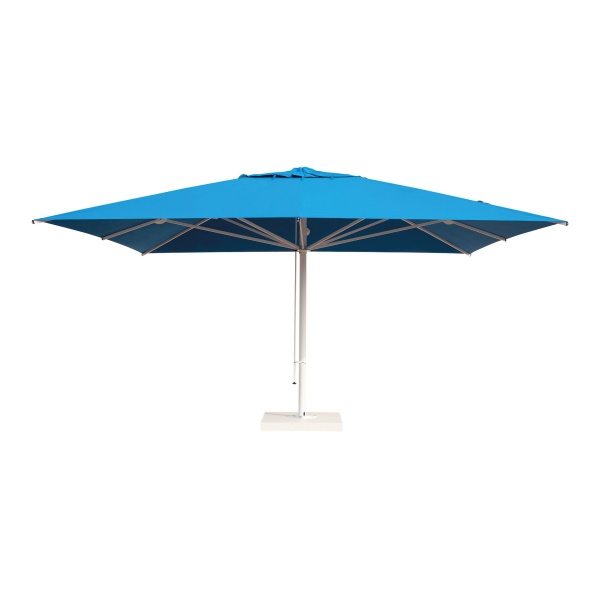
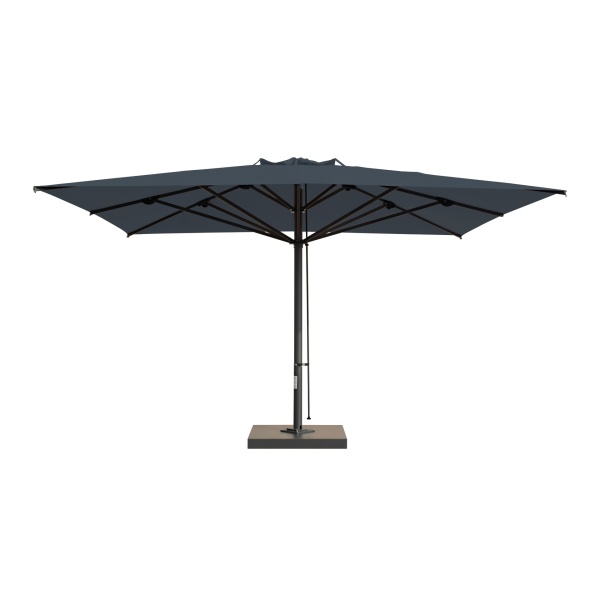
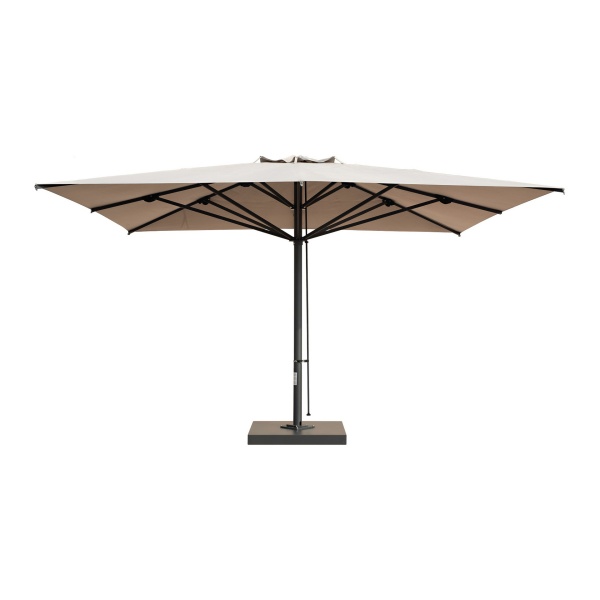
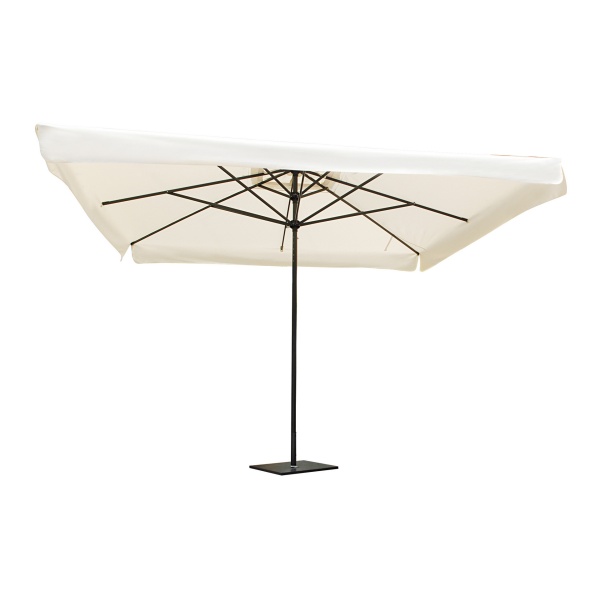
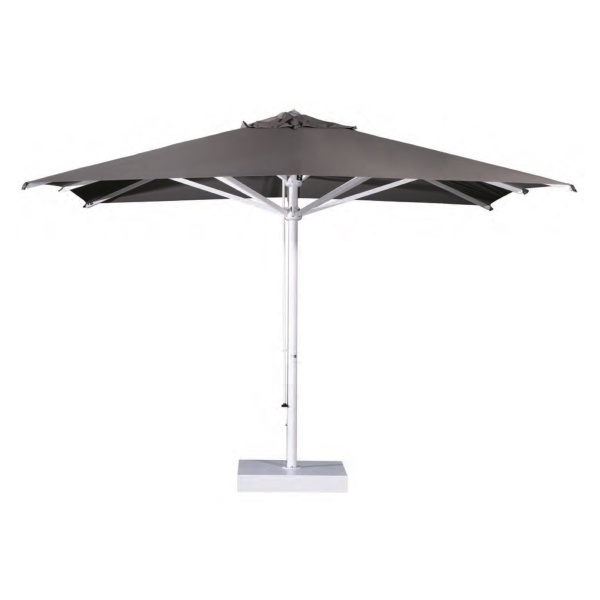
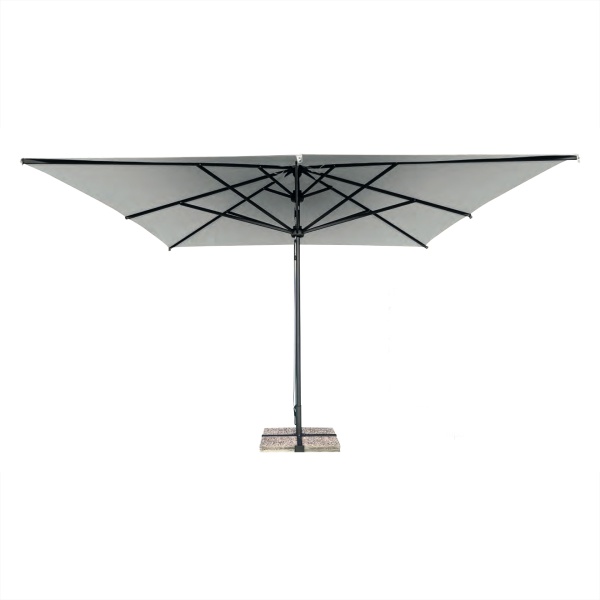
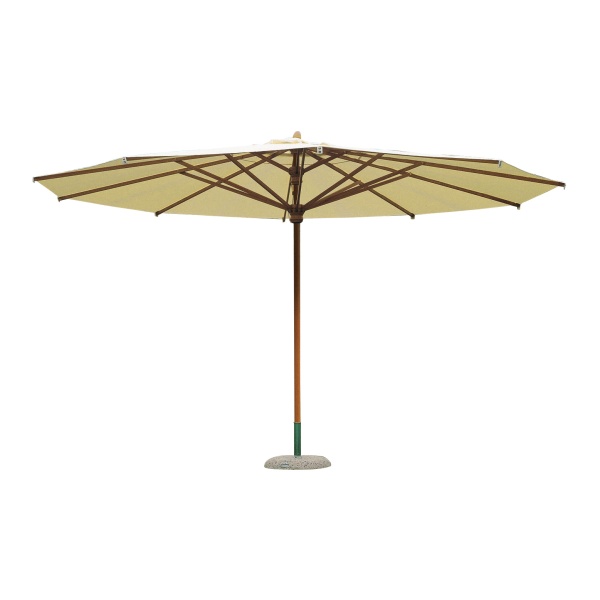
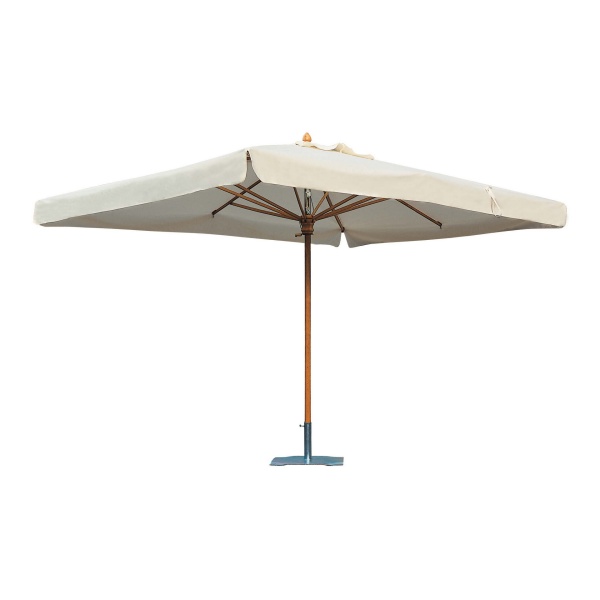
Telescopic parasols for restaurants and cafés are professional shading systems whose canopy rises vertically upwards and opens above the furniture without moving tables or chairs. Unlike standard side-opening parasols, the telescopic mechanism allows the system to be opened and closed even in dense seating layouts — without clearing space around the canopy perimeter.
Within the category of terrace parasols, telescopic models occupy a distinct niche: they solve an operational challenge that standard systems handle less efficiently — daily opening and closing on terraces with dense furniture layouts, where there is no room for lateral canopy movement. Contract-grade Scolaro systems with telescopic mechanisms are designed for intensive daily use in commercial hospitality environments.
Where a telescopic parasol performs better than a standard model
A standard parasol requires free space around the canopy during opening — guests and furniture must be positioned away from the mast so the canopy can unfold. On compact terraces with dense seating layouts, this is either impossible or requires staff to move outdoor chairs and tables every time the parasol is opened or closed.
The telescopic mechanism lifts the canopy vertically to working height before opening it horizontally. This means the parasol can be operated without moving furniture — even when chairs are positioned directly beside the mast. For restaurants that assemble and dismantle terraces daily, this can save 10–15 minutes of staff time every day.
A second scenario involves terraces with uneven flooring or split-level areas. The telescopic mast is height-adjustable, allowing the canopy level to be aligned across surfaces with height differences of up to 20–30 cm without additional supports or improvised solutions.
Construction and materials
The telescopic mechanism consists of two or three insertable mast sections fixed at the required height using either a crank system or a gas-assisted mechanism. Crank systems are more reliable for intensive daily use — they require no maintenance and maintain stable locking after hundreds of opening cycles. Gas-assisted systems are easier to operate but typically require replacement after 3–5 seasons of heavy commercial use.
The frame uses powder-coated aluminium profiles rated C3 for urban terraces or C4/C5 for coastal environments. With proper maintenance, the expected service life is 7–10 seasons. The canopy fabric is solution-dyed acrylic with a density starting from 250 g/m², UV resistance class 7–8 according to Xenotest standards and less than 3% UV transmission. A ventilation vent at the top of the canopy is an essential feature for exposed outdoor areas — it reduces wind pressure during gusts and increases permissible wind resistance in the open position by 1–2 Beaufort levels.
How telescopic parasols integrate into terrace systems
Telescopic models are most effective where operational simplicity is essential for daily use. For large elongated seating areas with a minimal number of supports, double canopy parasols are often more suitable. For lounge zones without a central mast interrupting the layout, cantilever parasols work better. For large permanent outdoor installations, 4×4 m parasols are commonly preferred.
Under the shading system, outdoor tables and seating can be arranged in standard configurations — the telescopic mechanism does not impose restrictions on the placement of outdoor furniture beneath the canopy. For selecting the correct base according to canopy size and surface type, see the section on parasol bases.
A telescopic parasol is the optimal solution for terraces with dense seating layouts and daily furniture handling: the canopy opens above tables without moving guests or furniture, while the adjustable mast height adapts the system to virtually any surface level.