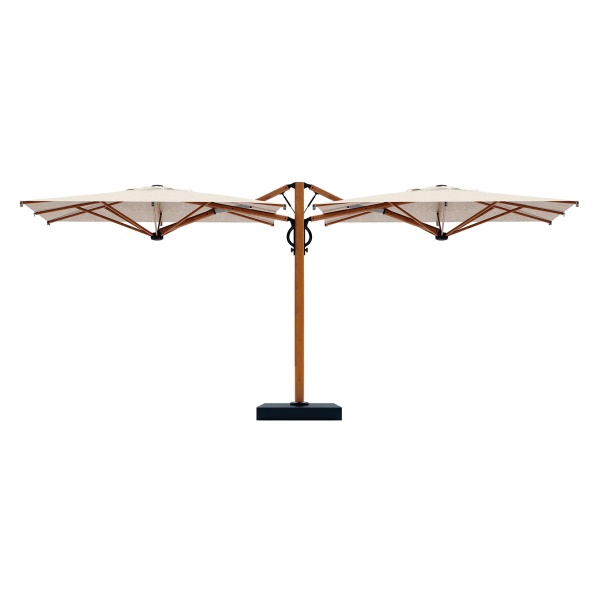
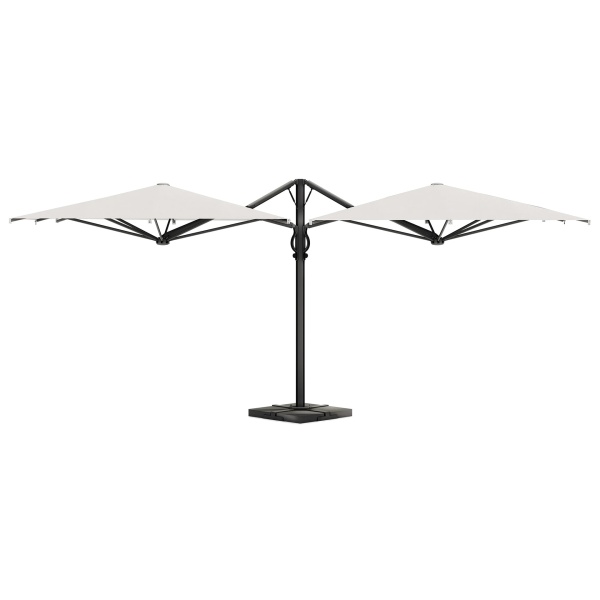
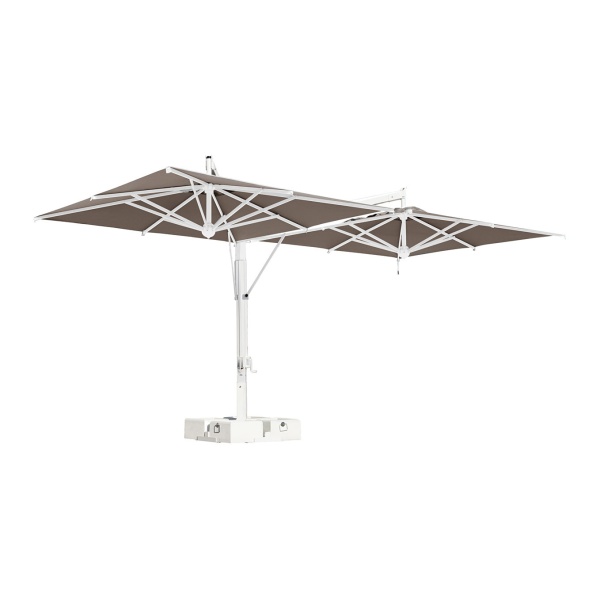
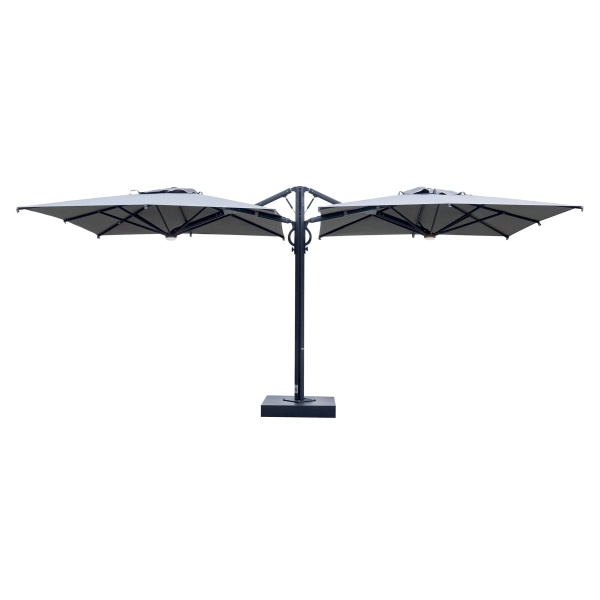
Double-canopy parasols for restaurant and hotel terraces are contract outdoor shading systems for hospitality venues designed to cover large and elongated seating areas with a minimal number of supports. Two canopies mounted on a single central mast create a continuous shaded line from 3×6 to 3.5×7 m — without additional bases between tables and without gaps in shade throughout the day.
Within the category of terrace parasols, double-canopy models occupy a separate niche: they solve a problem standard systems handle less efficiently — consistent shading for long façade seating rows, pool zones and rooftop spaces without overcrowding the terrace with supports. Contract-grade shading systems withstand winds up to Beaufort force 5–6 in the closed position and up to force 3–4 when open, provided the correct base is selected.
While compact areas are often better suited to 4×4 m parasols, and lounge spaces without a central mast typically require cantilever parasols, a double-canopy system performs best where a long seating layout needs to be covered by a single structure.
Where double-canopy parasols outperform standard models
A standard parasol usually covers an area up to 3–4 metres wide or in diameter. On a long terrace with 8–10 tables, this often means 3–4 separate parasols with multiple bases placed between guests. A double-canopy system solves the same task with one structure — and this is not only about aesthetics, but also about the operational logic of the space.
Fewer supports mean wider service routes for staff, fewer obstacles for guests and simpler daily cleaning of the terrace. For restaurants with high table turnover and active service, this is a direct operational advantage.
Applications in hospitality projects
Restaurant terraces along façades. The most common scenario is elongated seating arranged in one or two rows parallel to the building. A 3×6 or 3.5×7 m double-canopy system covers the entire row with a single structure. The result is uniform shade without interruptions, no bases between tables and a cleaner seating layout.
Beach clubs and pool areas. A wide uninterrupted shaded zone along the pool edge or beachfront without excessive fixing points. A double-canopy system makes it possible to organise a lounge area with outdoor chairs and sun loungers without central supports disrupting the relaxation zone.
Rooftop spaces. On rooftops, the number of fixing points is often structurally limited. One double-canopy system instead of two separate parasols means half the number of roof anchors while maintaining the same shaded area.
Hotel patios and breakfast areas. Consistent shade for large group seating arrangements without visually overloading the space with bases and supports. Combined with outdoor tables and chairs, they create a complete hospitality environment.
Sizes and shaded coverage area
Double-canopy systems are available in several standard formats. The correct size depends on terrace length, the number of tables in a row and the acceptable spacing between supports.
| Format | Shaded area | Number of tables | Recommended base | Recommended application |
|---|
| 2.5×5 m | 12.5 m² | 4–6 tables | from 200 kg or anchor fixing | Compact façade terrace |
| 3×6 m | 18 m² | 6–8 tables | from 250 kg or anchor fixing | Restaurant, café, bistro |
| 3.5×7 m | 24.5 m² | 8–12 tables | 300+ kg or anchor fixing | Hotel, beach club, restaurant |
Materials and construction: what defines durability
Frame. Powder-coated aluminium profile rated C3/C4 is the industry standard for contract double-canopy systems. It does not rust and withstands seasonal storage and daily use without maintenance. For coastal projects, C4/C5 protection with anodising or stainless steel fixing components is recommended. With proper care, the aluminium frame lasts 7–10 seasons.
Canopy fabric. Acrylic fabric with a density of 250–320 g/m² is the commercial standard for professional parasols. It blocks more than 97% of UV radiation, offers UV fade resistance rated 7–8 according to Xenotest and includes a water-repellent finish. Expected service life is 5–7 seasons under daily commercial use. Polyester without acrylic coating is a lower-cost alternative with a lifespan of 1–2 seasons.
Ventilation vent. An essential feature for double-canopy systems in exposed outdoor areas. With a total canopy area exceeding 18 m², wind loads are significantly higher than on a standard parasol. Ventilation openings at the top of each canopy reduce uplift forces and improve wind resistance in the open position by approximately 1–2 Beaufort levels.
Opening mechanism. For commercial use, telescopic parasols are the most practical option, allowing the canopy to close without moving furniture underneath. This is particularly important in restaurants where staff close parasols every evening without rearranging tables.
Base and fixing: safety first
A double-canopy parasol measuring 3×6 m has roughly twice the wind load area of a standard 3×3 m parasol. As a result, the requirements for bases and fixing systems are substantially higher.
Practical guidelines for selecting a parasol base: for a 2.5×5 m model in a sheltered location — from 100 kg; for a 3×6 m model on an exposed terrace — concrete fixing is recommended; for 3.5×7 m systems and larger — anchor fixing is mandatory regardless of site protection. For rooftop and coastal projects, a structural wind-load assessment should always be carried out before installation.
Branding and customisation
For hospitality groups, hotel chains and premium venues, double-canopy parasols are available with custom canopy branding — including logos, corporate colours or full-print designs using sublimation printing. The large canopy surface from 18 m² per system makes double-canopy parasols particularly effective branding elements in outdoor spaces.
Contract systems by Scolaro are available with bespoke customisation options including canopy colour, frame finish and branding. Minimum order quantities for branded production usually start from 1–3 systems depending on the model. Production lead time is typically 5–6 weeks.
How to choose a double-canopy parasol for your venue
The first criterion is the required shaded length. Measure the length of the seating row and add 30–50 cm on each side — this determines the minimum parasol size. For a row of six 80 cm tables with a total length of 4.8 m, a 3×6 m system is usually the optimal solution.
The second factor is site exposure and wind load. Open terraces, rooftops and coastal locations require anchor fixing. In sheltered courtyards, a heavy freestanding base from 100 kg may be sufficient.
The third consideration is the opening mechanism. For daily operation by staff, a telescopic system with one-person handling is recommended. For more static installations with infrequent closing, a standard crank mechanism may be suitable.
For a cohesive outdoor concept, double-canopy parasols are typically selected together with other products from the outdoor furniture category to ensure matching frame finishes, fabric colours and overall design consistency.
A double-canopy parasol is not simply an enlarged standard model, but a separate class of commercial shading system with different installation logic, load distribution and maintenance requirements. Choosing the correct structure, base and fabric pays for itself within the first season through increased terrace usability and reduced operating costs.